
The Practical Guide to LLM Marketing (an introduction)
Updated: 4 days ago
With 50% of consumers using AI-powered search today, AI and Large Language Models (LLMs) have become the central topic of many conversations within marketing teams. If you are a business owner, a marketing leader, or even an investor, you have no doubt been wrestling with the topics for the last year. In an earlier article we have highlighted how we think AI may disrupt search-marketing. This post intends to serve as a single, comprehensive guide to understanding both the “why” and the “how” of LLM marketing.
Why should I care about the impact of AI on digital marketing?
Relying on leads only finding your website through traditional search is becoming increasingly unrealistic today. Over the last year, research behaviour has undergone a major shift, with LLMs starting to become the new front doors to your business.

While Google still wears the crown for the place people research, AI is clearly disrupting the mix. Queries that generate AI Overviews (AIOs) have increased by 16 percentage points since October 2024, and informational LLM queries, by 11 points.
This appears to have impacted user behaviour, with our clients receiving an increase in website searches, but a reduction in website traffic. Many users are starting to prefer the easy-to-access, synthesised information they receive from LLMs and AIOs, over manually researching and reviewing websites. We are becoming lazier!
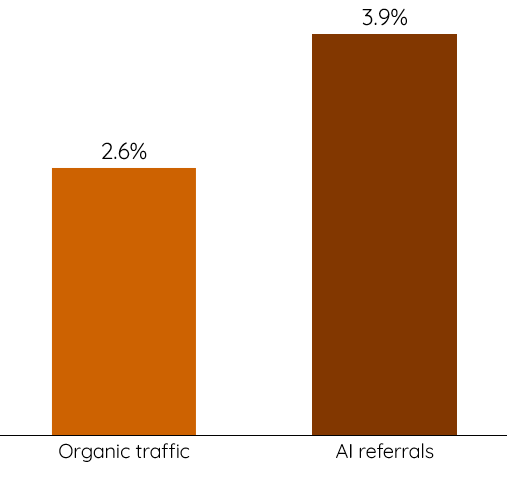
It also seems that users are quicker to make a decision based on this AI-generated information. Across our clients, we have noticed that the conversion rate of AI-referred traffic is meaningfully higher than the conversion rate of organic traffic.
Conversion Rate: Organic Traffic vs AI Referral Traffic
I am not saying to completely neglect traditional Google Search as a channel, far from that. Recent evidence actually suggests that LLMs complement search engine use rather than displacing it.
However, it has never been more important to ensure that your business is appearing in AI-generated answers because if not, you seriously risk being left behind.
How do I increase my AI visibility?

Firstly, there are three ways to be visible in AI-generated answers:
Three Ways to be Visible
Mentions – direct brand callouts in a response
Citations – links included in a response for user navigation
Sources – websites used to generate info in the response
To understand how to get your brand to appear as these, we must first touch on how LLMs work.
LLMs are machine learning models that generate direct, coherent and contextually relevant answers to user queries. They use pattern recognition to best match the user’s query with information obtained from two places:
Training data
And the web (the process of getting this information is called Retrieval Augmented Generation, or RAG)
In short, your brand’s visibility essentially comes from these two inputs. And naturally, the more you shape the information feeding into them, the more your brand will show up in AI responses.
The challenge with training data is that training only happens once per model. In other words, you have very limited influence over what gets baked into the internal knowledge base. On the other hand, web retrieval is different. It happens in real-time, and works through a process called query fan-out.
Query Fan-Out

The LLM segments a user’s prompt into shorter queries with varied intents
These fanned-out queries are run through search engines (like Google)
AI bots are distributed onto websites that appear in the results pages for these queries, and pick out relevant and credible information
The information is synthesised
Finally, a response is created
This is what you can optimise for, with many businesses seeing success from their efforts. For example, Ramp, an accounts payable business, applied various retrieval optimisation strategies, and within 1 month they increased their visibility by 19 percentage points.
The following article in this series will delve into the practical steps that can be taken to improve AIO and LLM visibility.
If you would like to see how your business benchmarks with our AI trackers or discuss your company’s approach to AI disruption in search marketing, please contact us.
The views expressed in this article are those of the author and are intended to inform and provoke discussion. They should not be treated as professional advice or relied upon as a substitute for advice specific to your circumstances.


