
Preparing for a private equity exit, where value can be created before the sale process starts
Most sellers don’t find out what buyers will think of the go-to-market (GTM) engine until it’s too late.
At Coppett Hill, we have the privilege of carrying out GTM due diligence (GTM DD) for a wide range of private equity funds, typically late in a sale process, which gives us deep and unique access to management teams, GTM systems. and data.
We’ve looked back at the last 20 GTM due diligence projects we’ve completed, on businesses that successfully secured private equity investment, to answer two questions:
What aspects of marketing, sales, and account management are the strongest and weakest?
Are there consistent themes across the customer lifecycle and GTM enablers for value creation?
This is the first of three articles that will set out what we found, what it means for maximising business valuations, and what management teams and investors can do about it now.
Key Takeaways:
Across our last 20 GTM due diligences, no dimension was consistently at the level required to deliver the plan set by management
Businesses are strongest across dimensions that take longer to build: sales conversion, team leadership, and branding. Buyers pay more when growth looks repeatable and scalable
The weakest areas (lead generation, enablement tools, and cadence & KPIs) are about systems, processes, and data, not people or product
It is never too early to set up data fundamentals in preparation for a sale. Clean up your CRM, lead tracking, and channel ROI so buyers see trends and momentum, not KPIs built a month before the data room opens
In every GTM due diligence we assess the business’s maturity (using a scale of 1–3) across twelve dimensions, to highlight areas that require investment to achieve management’s plan, which will ultimately underpin the business’s valuation. A 3 means limited investment/improvement in the dimension is required to achieve that plan, while a 1 means significant improvement is needed. Our analysis is based on businesses that have successfully secured private equity investment, so our sample has already been filtered to higher-quality businesses.
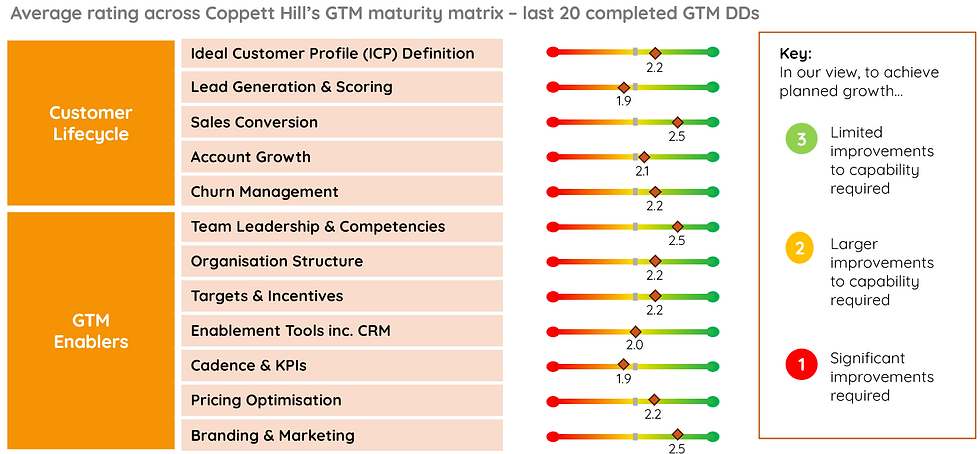
The chart below shows the average score for each area across all 20 deals. These include five dimensions across the customer lifecycle (ICP definition, lead generation & scoring, sales conversion, account growth, and churn management) and seven GTM enablers (team leadership, organisation structure, targets & incentives, enablement tools, cadence & KPIs, pricing, and branding).
There is of course variation in the different types of businesses we see; however, on average, no dimension achieves over 2.5/3.0 across the 20 GTM DDs assessed, while a number average closer to 2.0/3.0 – meaning larger improvements are required.
What are most businesses getting right?
Three dimensions share the top average score of 2.5/3.0: ‘Sales Conversion’, ‘Team Leadership & Competencies’, and ‘Branding & Marketing’. What is more often missing is the systematised approach to generating new leads (‘Lead Generation’), processes (‘Enablement Tools’), and data (‘Cadence & KPIs’) to support that growth engine.
How can I improve the go-to-market function in my business to attract higher valuations from private equity investors?
When we support management teams to prepare for exit, our work often results in three outcomes:
We identify short-term targeted opportunities, or ‘quick wins’, to be made to the GTM engine.
We help to support a robust data-backed growth plan that supports the equity story. This includes a clean dataset across marketing, sales, and customer data that can be used for due diligence processes.
Finally, our work ensures that management teams have the confidence to tell the story and respond to challenging questions that buyers may pose.
In the following article, we’ll look at the five customer lifecycle dimensions, surfacing consistent themes that arose across the 20 GTM DDs assessed, using that to highlight opportunities to prepare for exit and maximise value. In the final article in the series, we’ll look at the seven enablers, to identify ‘quick wins’ and key areas to address prior to a sale process.
So, what does this mean for exit value?
Across the businesses we assessed, most were typically stronger at the dimensions that take longer to build – strong sales functions, commercial leadership, and market presence. This isn’t a surprise, given private equity is already looking to invest in them. However, buyers will ultimately pay more for a business where they have confidence that they can invest in a repeatable and scalable way – this is where systems, processes, and data prove critical.
The encouraging part is that these dimensions are also among the most fixable: they don’t require a new product or a new leadership team, and much of the data required usually exists already.
What should I do when preparing to sell my business?
Start early – buyers want to see trends and momentum, not a set of KPIs created a month before the data room opens. Get your CRM in order: consistent usage, mandatory fields, and strong revenue operations hygiene. Improve your lead tracking and attribution to build a clearer understanding of ROI by channel.
If your business is valuable because it has high net revenue retention and low churn, or because it’s excellent at converting new leads, make sure you have a reliable database that can show these strengths. Turn those strengths into an evidence base a buyer can invest in – and use this same exercise to spot any data gaps worth fixing before a sale process.
If you’d like to discuss how you can prepare for an exit to maximise value, get in touch here.
The views expressed in this article are those of the author and are intended to inform and provoke discussion. They should not be treated as professional advice or relied upon as a substitute for advice specific to your circumstances.


